Quick Answer
“My pimple is gone — why does the mark look the same?”
Because the pimple and the mark are two related but different processes. The inflammation can settle before the pigmentation does — that flat brown or darker area is often post-inflammatory hyperpigmentation (PIH), a colour change that lingers after acne heals.
A flat dark mark is often not an acne scar. Scars change skin texture; PIH only changes colour, and it typically fades on its own over time — though the timeline varies from person to person.
A Pimple Can Disappear While the Mark It Leaves Stays
A pimple can disappear while the darker mark it leaves behind stays for much longer. That flat brown or darker area is often post-inflammatory hyperpigmentation (PIH) — a change in skin colour that can happen after inflammation such as acne has healed. It is different from a true acne scar, which usually changes the texture or structure of the skin.
If you have been wondering why your pimple is gone but the mark is still sitting there, you’re not imagining it. The inflammation can settle before the pigmentation does.
Pimple → inflammation → healing → lingering pigment. Your skin can finish the first part of that process while the darker mark remains visible.
Why Does a Pimple Leave a Dark Mark?
When acne becomes inflamed, the inflammation can trigger changes in the skin that leave behind extra pigment after the visible pimple settles. In people with medium to darker skin tones, these lingering dark spots can be especially noticeable and may last much longer than the original breakout.
That is why you might look in the mirror and think: “The pimple is gone. Why does my skin still look like I have one?” The answer is that the pimple and the mark are two related but different stages of the process. The active acne lesion may flatten and stop being red, swollen or painful. The pigmentation left behind can take longer to fade.
A 2025 review of acne-induced PIH also notes that UV radiation and other external factors can play a role in the development of post-inflammatory pigmentation.
What Happens to Your Skin After a Pimple Heals?
Think of a typical inflamed pimple as a short sequence:
01. Acne develops — a clogged pore and inflammation create the visible pimple.
02. Inflammation occurs — the immune response involved in the acne lesion creates inflammation around the area.
03. The pimple settles — swelling, redness and the active lesion gradually reduce.
04. Pigment may remain — the skin can be left with a flat area of darker colour even though the pimple itself is no longer active.
So the pimple can be gone before the dark mark is gone. That’s one reason acne can feel like it leaves a “second problem” behind. And this is also why preventing repeated inflammation matters. The American Academy of Dermatology notes that picking, popping or squeezing acne can make it take longer to clear and increase the risk of scarring and dark spots called PIH.
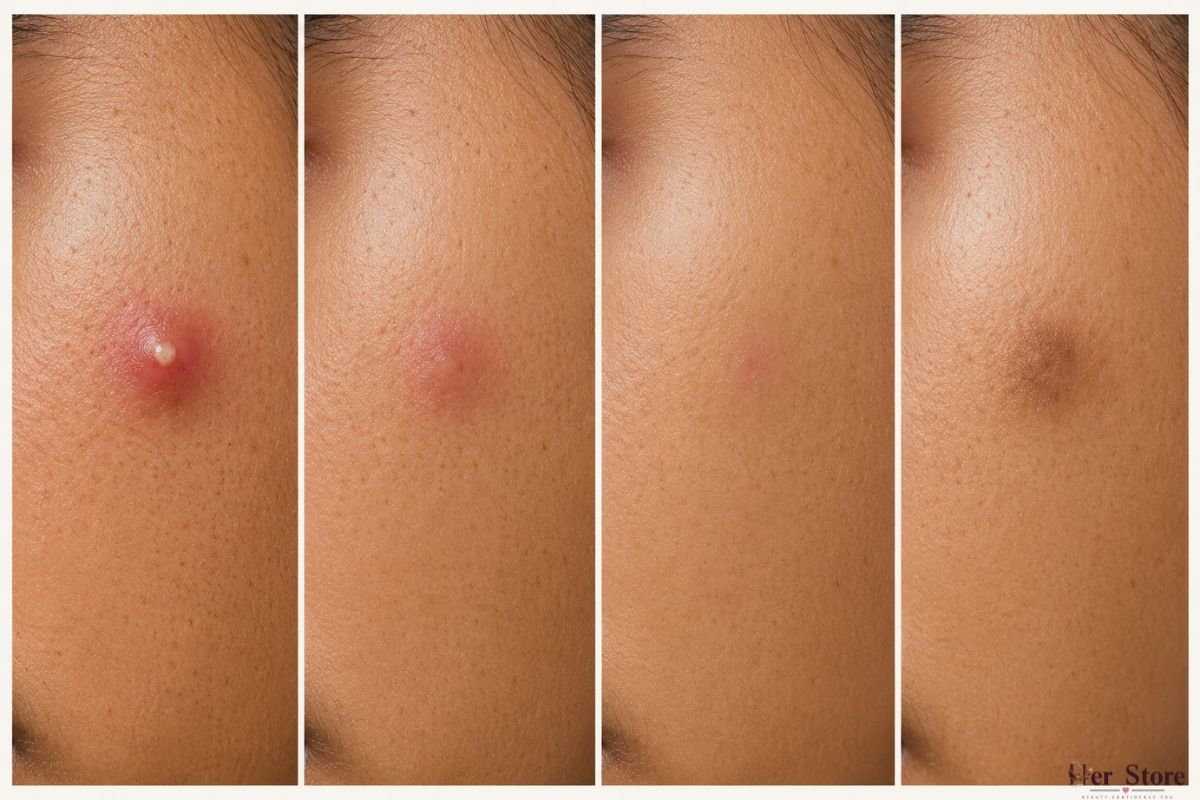
Skin healing and pigment fading do not always happen at the same speed.
What Is Post-Inflammatory Hyperpigmentation (PIH)?
Post-inflammatory hyperpigmentation, or PIH, is a darker area of skin that can remain after inflammation has healed. Acne is one common trigger. The mark may look brown, dark brown, bluish-gray in some skin tones, and flat rather than raised.
PIH is a pigment change, not necessarily active acne. And importantly, a flat dark mark is not automatically an acne scar. Research reviews describe acne-related hyperpigmentation as particularly important in people with skin of colour, where it can persist and become a major part of the visible impact of acne.
A recent 2026 review also highlights that acne-induced hyperpigmentation and post-inflammatory erythema are common acne sequelae, particularly in people with skin of colour, and can persist for months or longer.
Dark Mark vs Acne Scar: What's the Difference?
This is one of the most useful distinctions to understand.
Dark mark / PIH
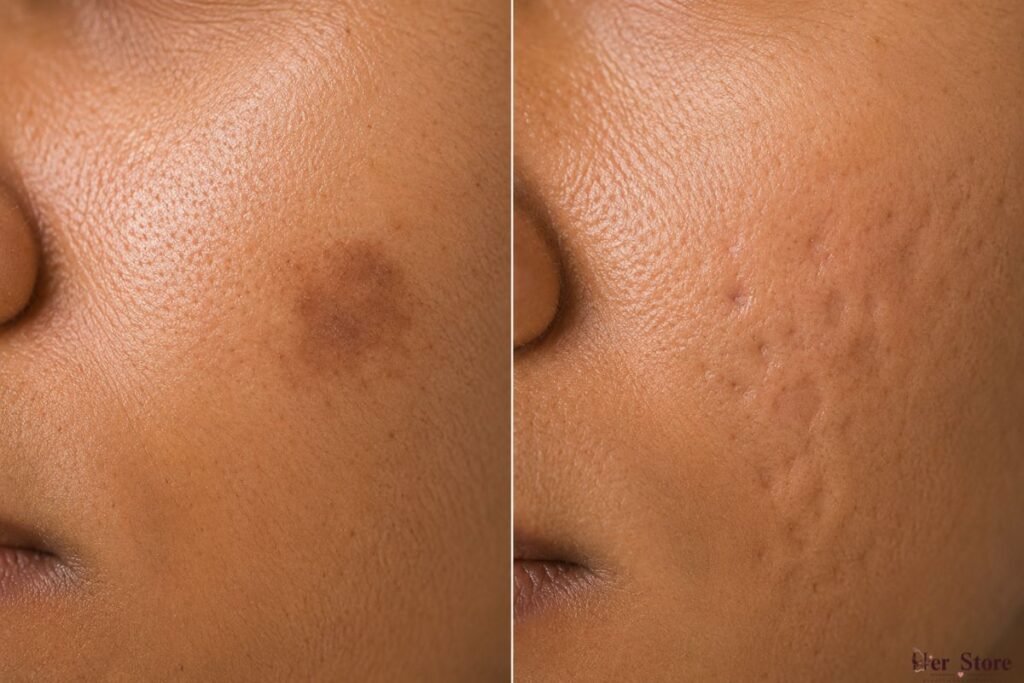
A dark mark from PIH is usually flat, mainly a change in colour, brown, darker or sometimes grayish, and left behind after the acne settles. The American Academy of Dermatology states that these flat PIH spots are not acne scars and usually fade over time, although fading can take time.
Acne scar
A true acne scar involves a change in the skin’s texture or structure. It may appear as a depression or indentation, a raised scar, or a lasting texture change.
The key question is: is the problem mainly colour, or has the skin’s surface actually changed? A flat brown mark is usually more consistent with PIH than a true acne scar. Of course, not every mark can be identified accurately from a photo or a quick look in the mirror. When you’re unsure, professional assessment is the safest way to know what you’re dealing with.
Why Can Dark Marks Last Longer Than the Acne?
Because the acne lesion and the pigmentation are different processes. An active pimple can settle relatively quickly while the pigment change remains visible.
How long a dark mark stays can vary from person to person. There isn’t one guaranteed timeline that applies to everyone, and research on treatment outcomes for acne-associated hyperpigmentation has limitations. A published systematic review found that evidence across treatment studies is still varied and that complete responses are not guaranteed. People with darker skin tones can also be more likely to develop noticeable and persistent PIH after inflammatory acne.
“Your dark marks will disappear in 7 days.” Real skin does not work on a fixed marketing timetable.
What Can Make Acne Dark Marks Worse?
Sometimes the original pimple is only part of the story.
1. Picking and squeezing
This is a big one. It can increase inflammation and increase the risk of scarring and dark spots. That moment of satisfaction from squeezing a pimple can be followed by a mark that stays much longer.
2. Aggressive scrubbing
Scrubbing harder does not mean your dark mark will disappear faster. Harsh physical irritation can make acne-prone skin more irritated. The AAD recommends gentle skin care rather than abrasive scrubbing.
3. Constantly changing products
If you introduce three or four strong products at the same time, you won’t know which one is helping or which one is causing irritation. The AAD advises sticking with treatment rather than constantly switching products, because repeated changes can irritate the skin.
4. Ignoring sun protection
UV exposure is an important part of pigmentation management. Recent review literature on acne-induced PIH identifies UV radiation among factors involved in its development, while dermatology guidance recommends broad-spectrum sun protection for acne-prone skin.
5. Expecting instant results
Dark marks often need patience. The goal should be consistent, tolerable care, not changing your entire routine every few days because the mirror hasn’t changed yet.
la roche posay anthelios ultra fluid spf 50 facial sunscreen sri lanka
Daily facial sun protection for a routine focused on managing acne and pigmentation concerns.
What Can You Do About Acne and Dark Marks?
There is no single product that works for every person. A better approach is to think in five parts.
1. Control active acne
The American Academy of Dermatology recommends treating acne rather than simply letting breakouts run their course, because controlling acne can help reduce future inflammation, dark spots and scarring. That doesn’t mean you need a complicated routine — it means the active acne itself should not be ignored.
2. Keep the routine gentle
When skin is irritated, adding more aggressive products isn’t automatically the answer. Focus on gentle cleansing, avoiding picking, avoiding aggressive scrubbing, using a suitable moisturizer, and choosing products your skin can tolerate.
3. Consider suitable targeted ingredients
This is where ingredients can become useful. The right option depends on the person’s skin, the type of acne, the pigmentation involved and how sensitive the skin is. More on those ingredients below.
4. Use daily sun protection
Sun protection is an important part of caring for pigmentation-prone skin. For acne-prone skin, the AAD recommends broad-spectrum, water-resistant sunscreen with SPF 30 or higher and suggests looking for non-comedogenic options.
5. Be consistent
Don’t build a routine that looks impressive on your bathroom shelf but is impossible to maintain. A simple routine you can follow consistently is usually more useful than an overloaded one.
Skincare Ingredients You Should Know
These ingredients come up frequently in acne and dark-spot discussions, but they are not universally suitable for everyone.
Salicylic Acid
Commonly used in acne-focused skincare because it helps exfoliate and unclog pores. The AAD lists salicylic acid among ingredients used in acne products, particularly for helping prevent new breakouts. It can be useful for some acne-prone routines, but overuse may cause dryness or irritation.
Azelaic Acid
Used in dermatology and skincare for acne and pigmentation concerns. It can be particularly relevant when someone is dealing with both breakouts and uneven-looking pigmentation. Research and expert reviews include azelaic acid among topical options used for acne-associated hyperpigmentation, although results vary and treatment should be matched to the individual.
Niacinamide
A form of vitamin B3 commonly used in skincare. It appears in formulas aimed at supporting the skin barrier and improving the appearance of uneven-looking skin tone. It can be a useful ingredient to know, but the product’s overall formula and your skin’s tolerance matter more than the ingredient name alone.
Retinoids
Vitamin A-related ingredients used in acne treatment. They can help with clogged pores and are also used in routines that address uneven pigmentation. The AAD lists retinoids among acne treatments and notes that retinol is one type of retinoid. They can also cause irritation and are not appropriate for everyone. Some retinoids require professional guidance, so don’t copy someone else’s prescription routine just because it worked for them.
Tranexamic Acid
Used in some pigmentation-focused skincare formulas. It is an ingredient you may come across when researching uneven pigmentation, but that does not mean every person with acne dark spots needs it. Evidence for topical approaches to PIH continues to evolve, so product selection should be based on the individual situation rather than a trend.
Sunscreen
Not an acne treatment, but it matters when pigmentation is a concern. Daily broad-spectrum protection can help reduce ongoing UV exposure while you’re caring for skin prone to dark marks. The AAD recommends SPF 30 or higher and advises people with acne-prone skin to consider non-comedogenic formulas.
A Simple Morning & Night Routine
You do not need a 10-step routine.
Morning
- Gentle cleanse
- Hydration / moisturizer if needed
- Sunscreen
Night
- Gentle cleanse
- Suitable targeted treatment
- Moisturizer
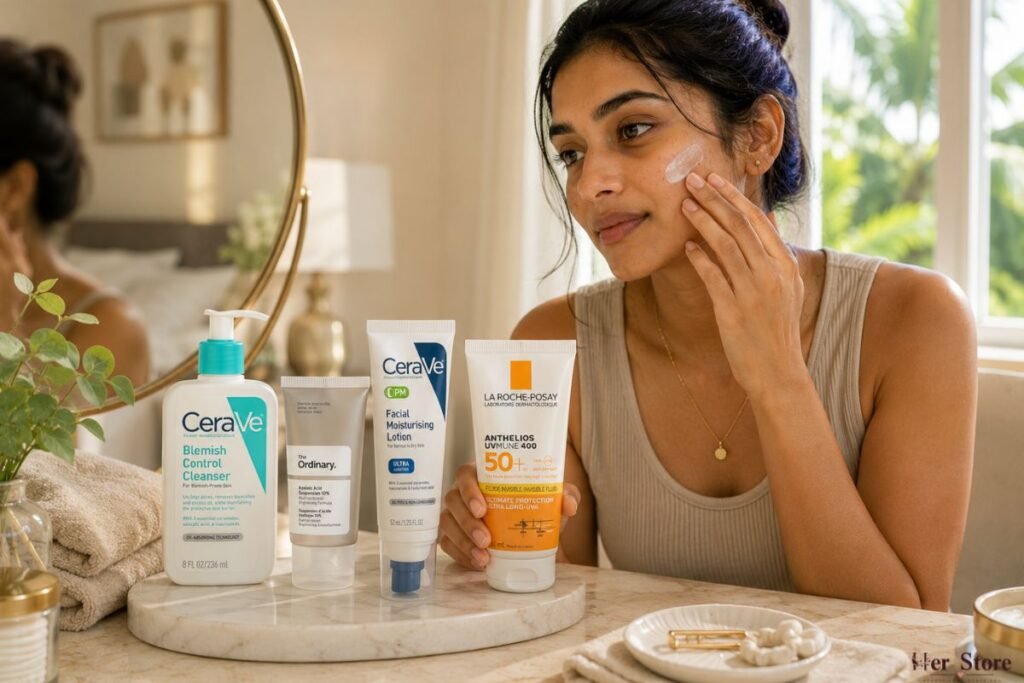
If you’re using a leave-on treatment in the morning, follow the product instructions and place it before moisturizer and sunscreen. A beginner could keep it even simpler: cleanse → moisturize. Then add one targeted product when there is a clear reason to do so. This keeps the routine easier to understand and makes it easier to work out which products your skin does or doesn’t tolerate.
Tools That Can Support Your Routine
Ingredients do the treatment work — but a few simple tools can make the routine itself easier to stick with, which matters more than people expect. Consistency is one of the biggest factors in managing dark marks over time. None of these tools treat PIH or acne on their own, and they’re optional additions, not replacements for the steps above.
Before cleansing — a facial steamer
A few minutes of gentle steam before your cleanse can help soften skin and make it more comfortable to remove makeup, sunscreen, and everyday buildup. This is a comfort step, not a treatment — skip it if you have actively inflamed or irritated acne, since heat can aggravate inflammation.
Benice Steam Inhaler Sri Lanka
A straightforward way to add a steam step without a complicated setup.
During your night treatment — a facial massager
Once your targeted serum is on, a gentle facial massager can help distribute product evenly and make application feel less like a chore. It doesn’t change what an ingredient like azelaic acid or niacinamide does — it just supports how you apply it.
Facial Gun Massage Face Massager Sri Lanka
Always use light pressure and avoid active breakouts.
After sun exposure — an ice roller
A quick cool-down can feel soothing on a hot day and may help with temporary puffiness, especially useful if you live somewhere warm and humid. It’s a comfort step, not a pigmentation treatment.
Silicone Ice Roller Face Neck Body
A simple, low-cost way to try this.
A word on all three: these tools support comfort and routine consistency. They don’t fade PIH, treat acne, or replace sunscreen and gentle skincare. If a device feels uncomfortable or irritating on active breakouts, stop and skip it — that’s more important than finishing a routine “correctly.”
When Should You See a Dermatologist?
Save this section. It is the checklist worth remembering.
- Don't constantly squeeze or pick pimples.
- Don't aggressively scrub dark marks.
- Don't introduce many strong active ingredients at once.
- Don't copy another person's prescription routine.
- Don't expect dark marks to disappear overnight.
- Don't assume every dark mark is an acne scar.
The AAD specifically warns that picking and squeezing can increase the risk of scarring and PIH, while repeated changes to acne treatment can irritate the skin.
What NOT to Do When You Have Acne Dark Marks
Professional assessment is worth considering when you have:
- Persistent or worsening acne
- Painful or deep acne
- Significant scarring
- Repeated breakouts
- Acne that is not improving with appropriate care
- Pigmentation that is a major concern
- Uncertainty about whether a mark is PIH, a scar or something else
The AAD specifically notes that dark spots after acne clears can be a reason to see a dermatologist, particularly when acne is causing significant inflammation. A dermatologist can also tell you whether you’re dealing with acne, PIH, scarring, post-inflammatory redness or another skin condition that needs different care.
This article is educational information, not a personal diagnosis or treatment plan.
Skincare Considerations for Sri Lankan Readers
Sri Lanka’s warm and humid conditions can influence how skincare products feel on the skin. That does not mean humidity automatically causes acne. It simply means texture and comfort can matter when you’re choosing products for everyday use. For many people, especially during hot days, lightweight and comfortable textures may be easier to keep using consistently.
If your routine feels heavy or greasy, consider looking at lightweight moisturizers, comfortable sunscreen textures, gentle cleansers, and products that suit acne-prone skin. A cooling step, like a few passes with an ice roller, can also make midday touch-ups more comfortable in hot weather — though it’s a comfort add-on, not a substitute for sun protection.
And remember that skincare does not replace sensible sun protection habits. Shade, protective clothing and sunscreen all have a role in reducing UV exposure.
Helpful Skincare Options at HerStore
The products below are examples of skincare options available at HerStore that relate to the ingredients and routine discussed in this guide. You do not need every product, and one person’s routine may look very different from another’s. Always check the individual product’s ingredients and directions before purchasing or using it — suitability varies by person.
Acne / Cleansing
Acne / Dark Marks
Hydration / Skin Support
Sun Protection
Summary
Key Takeaways
- A pimple can disappear while the pigmentation left behind remains visible for much longer.
- A flat dark mark after acne is often PIH, and PIH is different from a true acne scar.
- Picking, squeezing, harsh scrubbing and repeatedly changing products can make acne and dark marks harder to manage.
- A simple routine built around gentle care, appropriate acne management and daily sun protection is a sensible starting point.
- Ingredients such as salicylic acid, azelaic acid, niacinamide and retinoids may appear in acne or pigmentation-focused skincare, but no single ingredient is right for everyone.
- Simple tools — a facial steamer, a facial massager, an ice roller — can make a routine easier to stick with, but they support comfort and consistency, not pigmentation treatment.
- Persistent, painful or severe acne — or pigmentation you are unsure about — is worth discussing with a qualified healthcare professional.
Frequently Asked Questions
Tap a question — answers open instantly, no scrolling required.
A pimple can leave a dark mark because inflammation from acne can trigger a pigmentation change that remains after the visible pimple has healed. This flat discoloration is often called post-inflammatory hyperpigmentation, or PIH.
There is no single timeline for acne dark spots because fading varies by person, skin type, severity of inflammation, and other factors. PIH can persist for months or longer, so claims that every dark spot will disappear within a few days should be treated skeptically.
No. A flat dark mark is usually a pigmentation change such as PIH, while an acne scar involves a lasting change in skin texture or structure, such as an indentation or raised scar.
People with darker skin tones are more likely to develop noticeable post-inflammatory hyperpigmentation after inflammatory acne, and the marks can be more persistent.
No. Aggressive scrubbing can irritate acne-prone skin and is not a reliable way to remove PIH. Gentle skincare is a better starting point.
Yes. Sun protection matters when pigmentation is a concern because UV radiation can contribute to pigmentation processes, and dermatology guidance recommends broad-spectrum SPF 30 or higher sunscreen for acne-prone skin when exposed to the sun.
Not directly. Tools like ice rollers, steamers, and facial massagers can support comfort and help you stick to a routine, but they don't treat pigmentation or acne. Ingredients and sun protection do the actual work — the tools just make the process more pleasant.
Consider professional assessment when acne is persistent, painful, deep, repeatedly breaking out, leaving significant scars or dark spots, or not improving with appropriate care. A dermatologist can also help determine whether a lingering mark is PIH, a scar or another skin condition.
Medical & Research References
Key references used to support the educational points in this guide. These sources are for information only and do not represent an endorsement of HerStore.